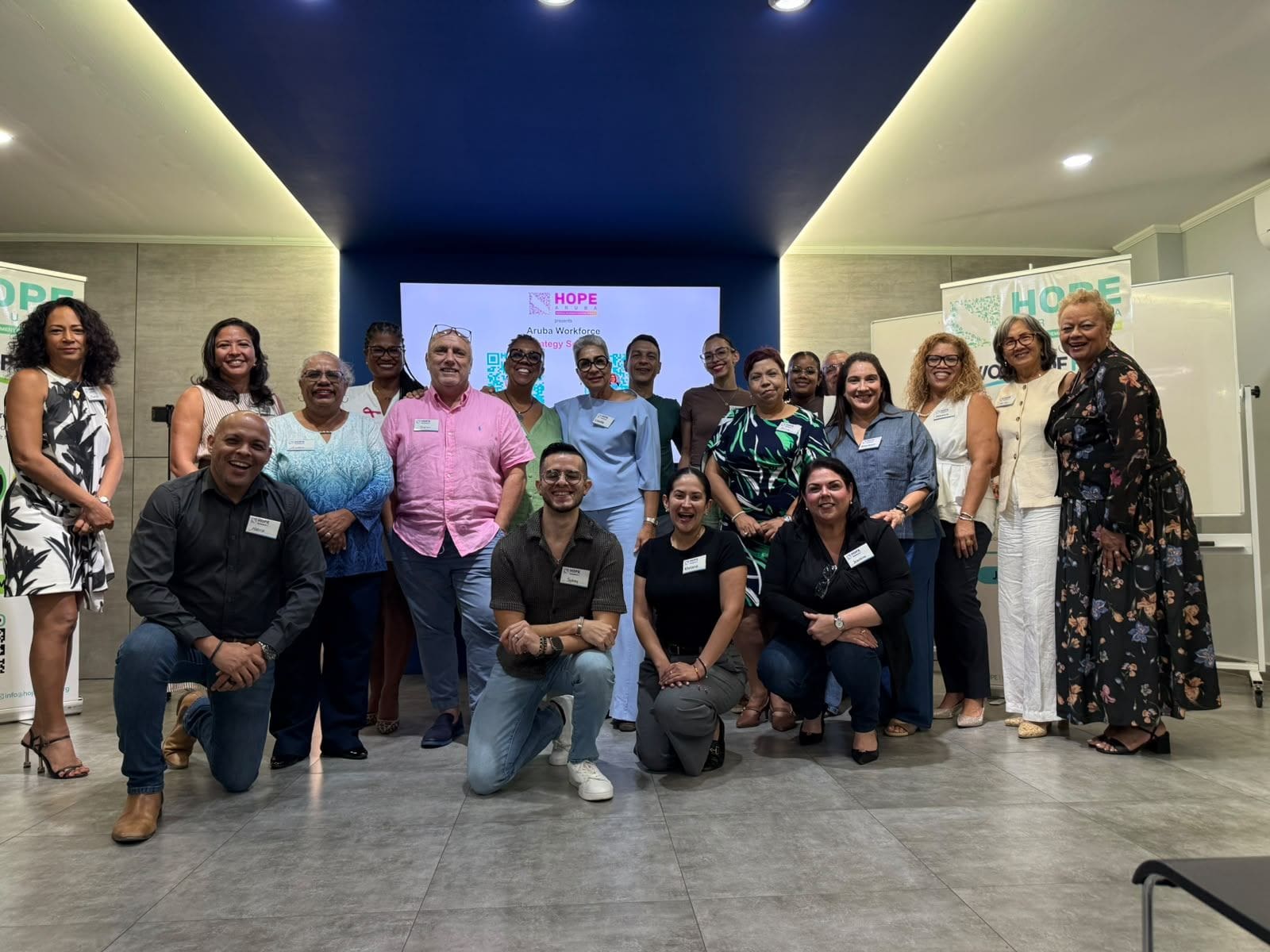
In October, HopeAruba and its partners co-created Aruba 2050, a series of sessions in which young Arubans and employers came together to look at the economic forces that have shaped the island and what they mean for the generation that will lead it. The full-day Gen Z Think Tank took place on October 24 at the University of Aruba, followed by two employer sessions on October 26 and 27 at the Aruba Trade and Industry Association (ATIA).
The sessions opened with a data-based presentation by Lisette Malmberg, President of HopeAruba, based on, among others, the Central Bank of Aruba and the Central Bureau of Statistics. The research traces a pattern from the abolition of slavery in 1863, through the Lago Refinery era to today’s tourism economy. While each period brought jobs and economic growth, access to land, businesses and other sources of wealth remained unequal. This shaped who could build assets, provide financial security for their families and pass wealth on to future generations. Looking ahead, it used The Perfect Storm, the 2026 analysis by Martijn Balkestein, Executive Director of the Aruba Chamber of Commerce and Industry, showing that Aruba’s population is ageing as fewer young people enter the workforce, and that if nothing changes, pressure on work, housing and care will grow. By making this research accessible to a wider audience, HopeAruba wants to bring important knowledge into the public conversation, so more people can understand the forces that have shaped Aruba’s society and economy.
In the Youth Think Tank, young role models aged 16 to 28 used Futures Thinking to look at what Aruba has inherited, how its economy works today and what the island could look like in 2050 if nothing changes. Through Design Thinking, they then started from their own experiences to imagine a different future and asked themselves who they would need to become to build it. It was a demanding day, and they stayed engaged and open from start to finish. Afterwards, they shared that they valued being heard and that it was a comfort to know they were not alone in not having all the answers.
In the employer sessions, HR professionals and business owners from seventeen organizations looked at their future workforce through the lens of Aruba 2050 and found the part on generations in the workplace particularly insightful. What stood out is that young people want what earlier generations wanted, namely ownership, progression, respect and belonging, but a salary alone no longer brings these within reach. The workplace has changed, through technology and its people, and organizations must adapt to attract and keep the next generation. There is a gap between what young people need and what today’s workplace offers, and conversations like these are essential for anyone who cares about Aruba’s future. Employers asked for the conversation to continue.
The sessions were designed and facilitated with Deon Bisslik and Viviana Lopez Paz, young Aruban professionals in the Netherlands, of MLTPL Choice, with contributions from Sharleen Tromp of Lead by Design. HopeAruba thanks the University of Aruba, ATIA and every young person, employer and partner who gave their time.
HopeAruba is analyzing the outcomes and preparing a public session to present them. The Aruba 2050 presentation is available at hopearuba.org, and updates will follow there and in the HopeAruba newsletter.