

Meeting local food demand in the Dutch Caribbean islands is largely a question of space, water, and energy, and it remains a significant challenge. The land required is substantial, especially when taking into account not only the local population but also the large number of tourists who visit Aruba each year.
These findings come from a recent study by a Dutch institute on food security in the Dutch Caribbean. The report also references the newly established CariFoodFund, for which the Netherlands has made €18 million available. A delegation from the fund is currently visiting the region.
According to the baseline assessment, full food self-sufficiency across the six Caribbean islands of the Kingdom is considered highly unrealistic. This is not because local agriculture cannot exist, but because the available land on the islands is simply too limited.
For the first time, the study not only measures local food production but also examines how much land is actually used for agriculture. The results highlight how small the agricultural sector is across many of the islands.
Land use across the islands
In Aruba, around 34 hectares are currently used for food production, representing about 0.19 percent of the island’s total surface area. In Bonaire, the figure is even lower, with just 1.8 hectares used, or roughly 0.01 percent of the island’s land area.
Researchers say these figures help explain why full self-sufficiency is so difficult to achieve. The islands face not only limited land availability but also harsh conditions such as drought, water scarcity, and high energy costs. Even modern farming methods like hydroponics and climate-controlled agriculture require significant energy for irrigation, cooling, and production systems.

Hectares required
The study also presents theoretical scenarios showing what full self-sufficiency would require, and the scale is considerable.
For Aruba, meeting all food needs locally would require nearly 690 square kilometers of agricultural land, almost four times the island’s total surface area. Meat production is particularly land-intensive, with beef alone requiring more than 623 square kilometers.
Bonaire faces similar constraints. Full self-sufficiency would require an estimated 99 square kilometers of agricultural land, more than one-third of the island’s total area. Meat and dairy production place especially heavy pressure on land use.
Rethinking food security
The report suggests these findings shift the way food security should be understood. The focus is no longer simply on whether islands can produce more locally, but on which types of production are realistically feasible.
Researchers therefore highlight product groups that offer the greatest potential for local production. Vegetables, leafy greens, eggs, and certain types of fish are identified as the most viable options. In contrast, meat and dairy production quickly face significant limitations.
Different food production profiles
This also explains why the islands are developing distinct agricultural profiles.
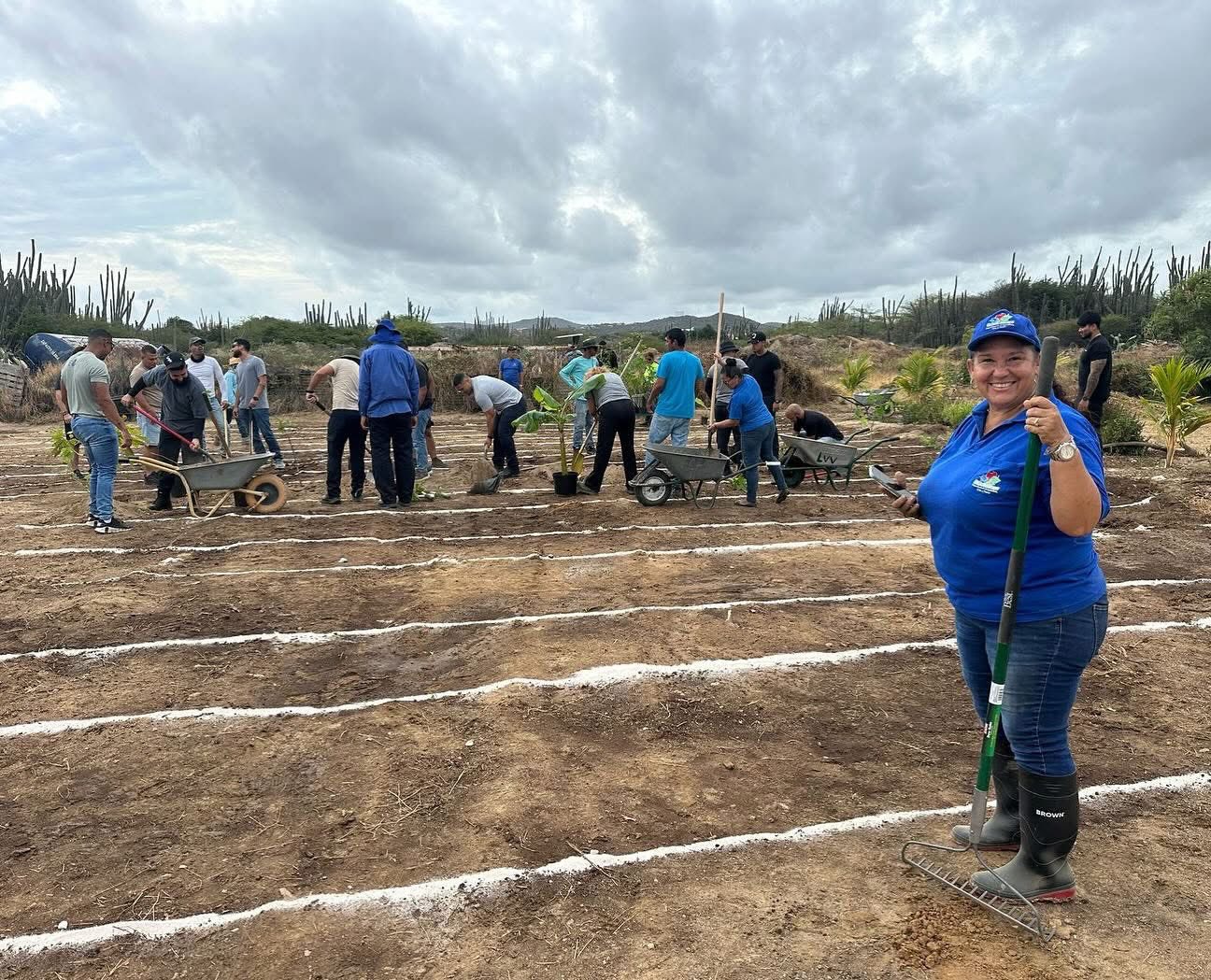
Aruba, for example, is focusing on specialized production such as mushrooms and hydroponic leafy greens. This allows for relatively strong output in specific niches, even though the broader food system remains heavily dependent on imports.
Bonaire, meanwhile, shows how even a small island with limited producers can achieve relatively high production levels in certain categories. Lettuce, leafy vegetables, and eggs are particularly important components of its local agriculture.
Curaçao has the most diversified agricultural sector among the islands, largely due to its larger scale, infrastructure, and market size. However, it still relies on imports for more than 91 percent of its food supply.
The study also adds nuance to the debate on food sovereignty. Researchers do not consider full independence from imports realistic. Instead, imports are expected to remain the foundation of food supply across the islands.
At the same time, there are opportunities to reduce vulnerability to global supply disruptions. Local production can strengthen resilience by providing fresher products, creating a buffer stock, and improving stability during temporary interruptions in transport and logistics.
This is particularly important given that the islands typically only hold a few days’ worth of food in stock if imports are disrupted. While local agriculture cannot replace imports, it is considered strategically important for improving food security.
