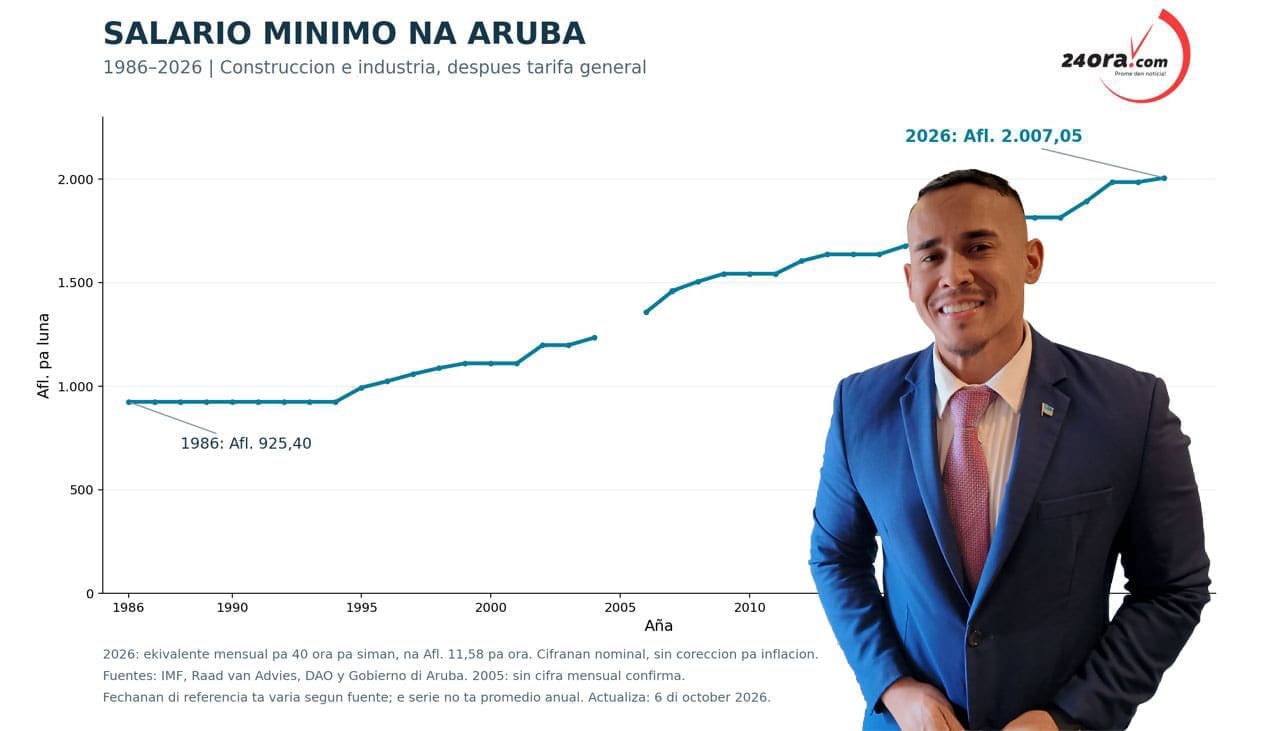
Minister of Labor Wendrick Cicilia supports raising Aruba’s minimum wage to help workers cope with the rising cost of living. However, he believes any increase must be carefully planned to ensure that businesses, particularly small and medium-sized enterprises, can manage the additional costs.
The discussion centers on whether Aruba’s current minimum wage provides workers with enough income to cover their basic living expenses. A key concern is the gap between what lower-income workers earn and the amount needed to support a household.
Cicilia questioned whether a monthly income of just 2,000 florins is enough for a parent to support a family, especially when the estimated subsistence level is around 2,700 florins per month, according to figures mentioned during the debate. This represents a difference of approximately 700 florins per month, highlighting the financial challenges that working families may face.
The debate also raises questions about how to improve wages without creating additional financial difficulties for employers. While higher wages could help workers afford essential expenses, they would also increase labor costs for businesses. This is particularly relevant for small and medium-sized enterprises, which may have less financial flexibility than larger companies.
According to Cicilia, improving workers’ financial situations is important, but any adjustment to the minimum wage must take the broader economic impact into account. The minister believes a balance must be found between the needs of employees and the financial capacity of employers.
To address these concerns, Cicilia indicated that the proposed minimum wage increase would be accompanied by a compensation package for the business sector. The intention is to help employers manage the additional costs and prevent the increase from placing excessive pressure on smaller businesses.
The minister emphasized that the objective is not simply to raise wages, but to improve workers’ quality of life while protecting the businesses that provide jobs and contribute to Aruba’s economy.
Although Cicilia has expressed support for a responsible minimum wage increase, important questions remain about the proposed compensation package, including what assistance businesses would receive and how the measures would be implemented.
The debate therefore involves two closely connected priorities: ensuring that workers can better afford their basic needs and making sure businesses remain financially capable of supporting those higher wages.
For Cicilia, the challenge is to develop an approach that addresses both concerns without placing an excessive burden on either workers or employers.