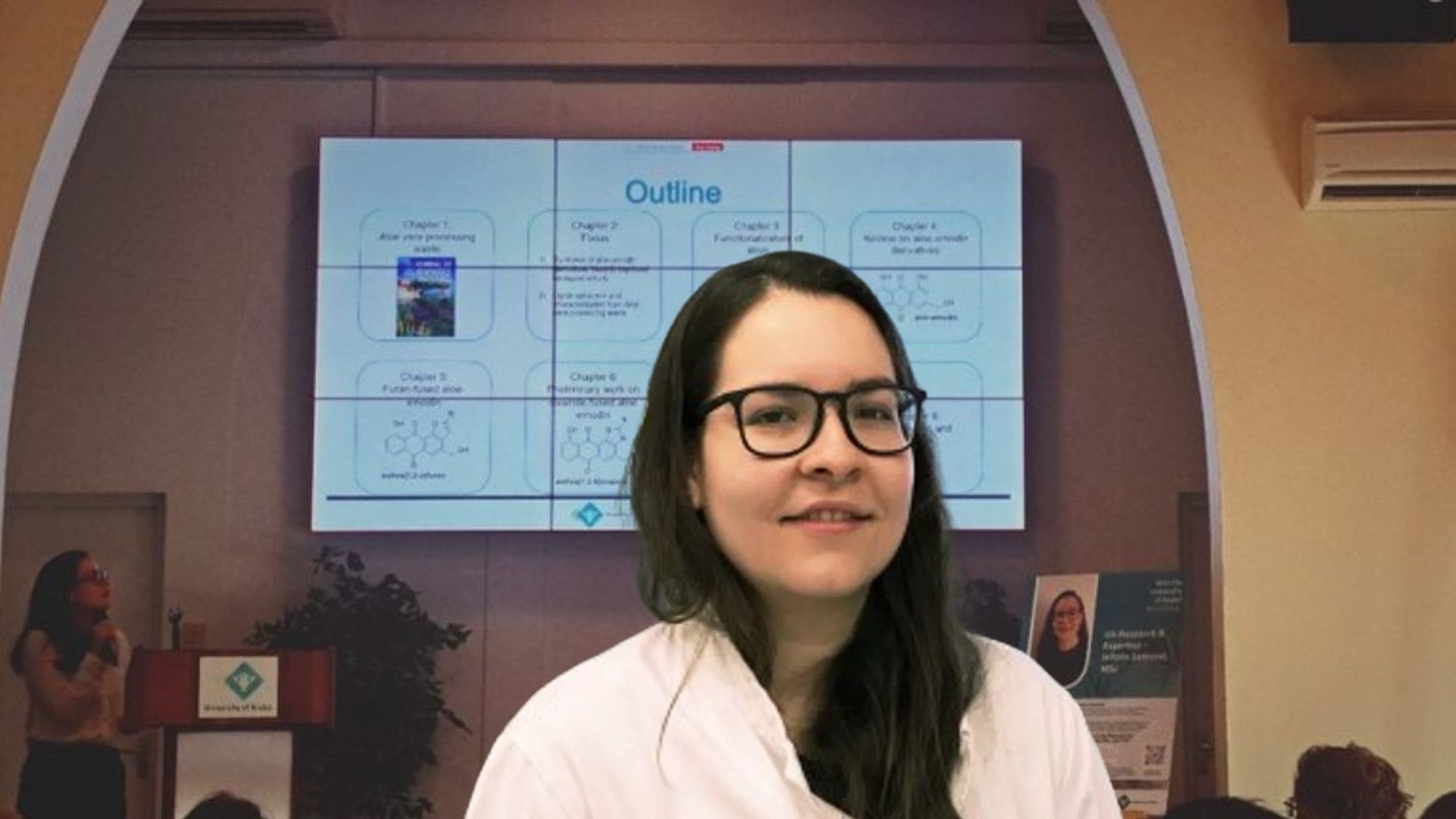
Aruban researcher Jeltzlin Zaïnah Semerel has earned a doctorate after investigating how waste from aloe vera production in Aruba and Curaçao could be turned into valuable chemical compounds. Some of these compounds may have potential medical applications, including the development of new medicines.
Semerel defended her doctoral thesis, Valorization of Aloe vera Processing Waste, on Tuesday at the University of Aruba. Her research explored how plant remains, including the green outer skin of aloe vera leaves and the bitter yellow liquid, can be processed into useful raw materials.
In a scientific study published earlier this year, Semerel and six colleagues presented six new chemical compounds. One showed particularly strong activity against certain lung and breast cancer cells in laboratory tests. However, the findings are preliminary, and further research is needed to determine whether these compounds could eventually be used in medicine.
From agricultural waste to valuable raw materials
Aloe vera has been part of Aruba’s history for generations. The plant is primarily processed to extract the gel from its leaves, which is used in cosmetics and personal care products. This process also generates large amounts of plant waste.
These remains formed the basis of Semerel’s research, which was conducted through the University of Aruba’s SISSTEM program in collaboration with KU Leuven in Belgium.
Her research focused on small island economies such as Aruba and Curaçao, where limited space and high processing costs make it particularly worthwhile to explore ways of reusing locally available materials.
According to an earlier scientific publication by Semerel and her colleagues, the company Curaloe in Curaçao produced approximately 4,000 kilograms of aloe leaf skin waste per month during the period studied. The material was mainly treated as agricultural waste or used as fertilizer.
However, the leaf skins and bitter yellow liquid also contain chemical compounds with potential scientific and commercial value. These include aloin, aloe-emodin and aloeresin, which are being studied for their biological properties and possible applications.
Developing new chemical compounds
Semerel investigated methods for extracting and purifying these substances from aloe vera waste, including microwave-assisted extraction using specialized solvents.
The extracted compounds can then be chemically modified to change their molecular structures and potentially improve or alter their biological properties.
The research explored possible antioxidant, anti-inflammatory, antimicrobial and antiviral effects, as well as the ability to inhibit cancer cells. By combining agricultural waste processing with chemical research, the study examines how materials that would otherwise be discarded could become valuable resources.
Promising results in cancer cell tests
On May 15, Semerel and six colleagues published a study in the scientific journal Molecules, presenting six new compounds based on aloe-emodin, a substance that occurs naturally in aloe vera and other plants.
The researchers tested the compounds on several human cancer cell lines grown in laboratory conditions. These included cells associated with lung, breast, colon, liver and ovarian cancers.
One compound, identified as 10c, showed particularly strong activity against lung and breast cancer cells.
The researchers measured an IC50 value of 0.49 micromolar for lung cancer cells and 2.91 micromolar for breast cancer cells. These values indicate the concentration required to reduce cell viability by half under the test conditions. In general, a lower IC50 value indicates stronger activity.
Based on these findings, the researchers identified compound 10c as a promising candidate for further investigation into potential medical applications.
Further research needed
Despite the promising laboratory results, the findings do not mean that a new cancer treatment has been discovered. The experiments were conducted on cells grown in laboratory conditions, not on patients.
Additional research is needed to assess the compound’s safety, determine whether it selectively affects cancer cells and establish whether its activity remains effective in a living organism.
The study also does not establish whether the aloe-emodin used to develop the compounds was actually extracted from aloe vera waste originating in Aruba or Curaçao.
Potential economic benefits for Aruba and Curaçao
Semerel’s research could have implications beyond medicine. It suggests that the aloe vera industry, which traditionally focuses on extracting gel for cosmetics and personal care products, may also provide raw materials for high-value chemical applications.
However, further studies are needed to determine whether the extraction and processing methods are technically and economically viable on a commercial scale.
For islands such as Aruba and Curaçao, where resources are limited and many industrial products must be imported, reusing agricultural waste could support the development of a circular economy. This approach aims to reduce waste by finding new uses for materials that would otherwise be discarded.